Posted by: Muhammad Asad Ishaq (Basic of Photography)
Photography is one of the most rewarding hobbies and professions in the world. Whether you want to capture unforgettable travel moments, create beautiful family portraits, photograph wildlife, or even start a photography business, understanding the basics is the first step toward taking better pictures.
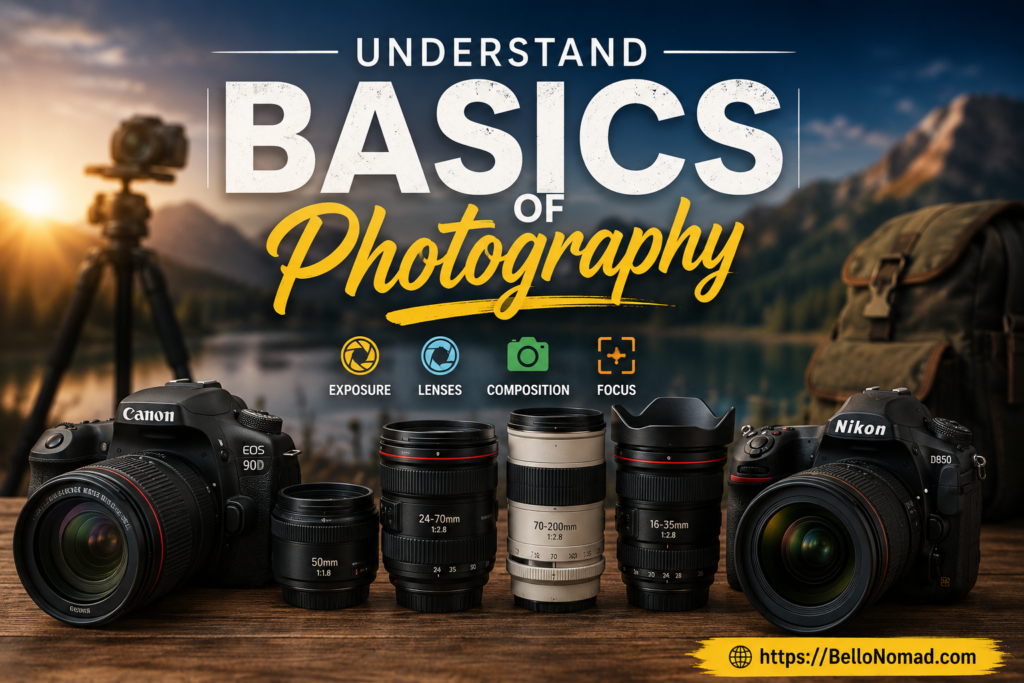
Modern smartphones have made photography accessible to almost everyone, but learning how cameras work can dramatically improve your images. This guide explains the fundamentals of photography, compares DSLR cameras with mobile phones, introduces different types of lenses, explains the exposure triangle, and highlights some of the world’s most popular DSLR and mirrorless cameras.
What is Photography?
Photography is the art and science of capturing light to create an image. The word photography comes from the Greek words “photo” (light) and “graphy” (drawing or writing), meaning “drawing with light.”
Every camera—whether it’s a smartphone, DSLR, or mirrorless camera—works by collecting light through a lens and recording it on a digital sensor. The amount of light reaching the sensor determines how bright or dark the image appears.
However, great photography is not just about using an expensive camera. It involves understanding composition, lighting, timing, perspective, and storytelling. A skilled photographer knows how to use available light and camera settings to create visually appealing photographs.
Illustration
Imagine standing in front of a beautiful mountain during sunrise.
- A beginner may simply point the camera and press the shutter button.
- An experienced photographer waits for the golden light, adjusts the exposure, chooses the right lens, frames the composition carefully, and captures a stunning image with rich colors and detail.
The difference lies in understanding photography fundamentals rather than simply owning better equipment.
DSLR vs Mobile Photography
Today’s smartphones produce impressive images, especially in daylight. Thanks to artificial intelligence (AI), image processing, and computational photography, mobile cameras have improved significantly. However, dedicated cameras still offer greater flexibility and superior image quality.
| Feature | DSLR/Mirrorless Camera | Smartphone |
|---|---|---|
| Sensor Size | Large | Small |
| Image Quality | Excellent | Good |
| Lens Options | Interchangeable | Mostly Fixed |
| Optical Zoom | Yes | Limited |
| Manual Controls | Full | Limited |
| Low-Light Performance | Excellent | Average |
| Battery Life | Longer | Moderate |
| Portability | Less Portable | Extremely Portable |
Advantages of Smartphones
- Easy to carry everywhere.
- Quick sharing on social media.
- AI automatically improves photos.
- Ideal for casual photography.
- Excellent for travel snapshots.
Advantages of DSLR and Mirrorless Cameras
- Larger sensors capture more detail.
- Better performance in low light.
- Interchangeable lenses for different photography styles.
- Faster autofocus and continuous shooting.
- Greater control over exposure settings.
- Higher-quality RAW image files for editing.
Illustration
Suppose you’re photographing a bird sitting on a tree.
A smartphone may capture the bird, but zooming in often reduces image quality. A DSLR or mirrorless camera fitted with a telephoto lens can capture sharp feathers, vibrant colors, and fine details from a considerable distance.
Camera Lenses and Their Types
A lens controls how much light enters the camera and determines the field of view. Choosing the right lens is often more important than choosing the camera itself.
1. Standard Lens (35mm–70mm)
A standard lens closely resembles the perspective of the human eye. It is suitable for portraits, street photography, and everyday photography.
Illustration: Photographing friends at a café or walking through city streets.
2. Wide-Angle Lens (10mm–35mm)
Wide-angle lenses capture a much larger area within the frame, making them perfect for landscapes, architecture, and interiors.
Illustration: Capturing an entire mountain range or photographing a large mosque from a close distance.
3. Telephoto Lens (70mm–600mm)
Telephoto lenses bring distant subjects much closer without sacrificing image quality.
These lenses are widely used for:
- Wildlife photography
- Sports photography
- Bird photography
- Moon photography
Illustration: Photographing an eagle perched high on a tree from hundreds of meters away.
4. Macro Lens
Macro lenses are designed to photograph tiny subjects at life-size magnification.
They are ideal for:
- Flowers
- Butterflies
- Insects
- Jewelry
- Product photography
Illustration: Capturing the tiny water droplets on a flower petal with incredible detail.
5. Prime Lens
Prime lenses have a fixed focal length (such as 35mm, 50mm, or 85mm).
Advantages include:
- Sharper images
- Larger apertures
- Better low-light performance
- Beautiful background blur (bokeh)
Illustration: Taking a portrait where the person’s face is perfectly sharp while the background appears soft and creamy.
Understanding the Exposure Triangle
The Exposure Triangle is one of the most important concepts in photography. It consists of three camera settings that work together to determine how bright or dark a photograph appears.
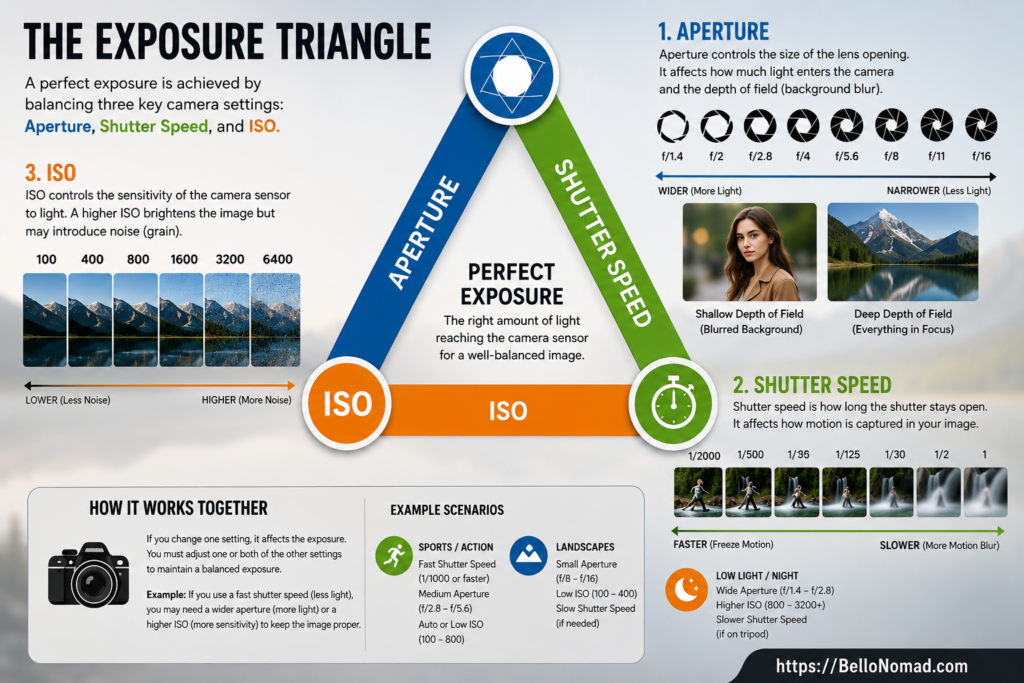
These settings are:
- Aperture
- Shutter Speed
- ISO
Balancing these three elements allows photographers to achieve proper exposure.
1. Aperture
Aperture refers to the opening inside the lens that allows light to enter the camera.
- Lower f-number (f/1.8) = Larger opening = More light.
- Higher f-number (f/16) = Smaller opening = Less light.
Aperture also controls depth of field, or how much of the image is in focus.
Illustration
A portrait taken at f/1.8 creates a beautifully blurred background, making the subject stand out. The same portrait taken at f/16 keeps both the subject and the background in sharp focus.
2. Shutter Speed
Shutter speed determines how long the camera sensor is exposed to light.
Fast shutter speeds freeze motion, while slower shutter speeds create motion blur.
Examples:
- 1/2000 sec → Flying bird
- 1/1000 sec → Sports
- 1/250 sec → Walking people
- 1 second → Waterfalls
- 20 seconds → Star trails
Illustration
A fast shutter speed freezes a football player kicking the ball. A slow shutter speed turns flowing water into a smooth, silky effect.
3. ISO
ISO controls the camera sensor’s sensitivity to light.
- ISO 100 = Highest image quality.
- ISO 400 = Cloudy weather.
- ISO 800–1600 = Indoor photography.
- ISO 3200+ = Very low-light conditions.
Increasing ISO brightens the image but also introduces digital noise or grain.
Illustration
Taking a photograph inside a dimly lit restaurant may require increasing ISO to maintain proper brightness without using flash.
Famous DSLR and Mirrorless Cameras
If you’re planning to purchase a camera, these models are among the most respected in the photography industry.
Popular DSLR Cameras
- Canon EOS 90D
- Canon EOS 5D Mark IV
- Canon EOS Rebel T8i (850D)
- Nikon D7500
- Nikon D850
- Nikon D780
- Pentax K-1 Mark II
Popular Mirrorless Cameras
- Sony Alpha A7 IV
- Sony Alpha A6700
- Sony Alpha A1 II
- Canon EOS R6 Mark II
- Canon EOS R5 Mark II
- Canon EOS R8
- Nikon Z6 III
- Nikon Z8
- Nikon Z9
- Fujifilm X-T5
- Fujifilm X-H2
- OM System OM-1 Mark II
- Panasonic Lumix S5 II
Mirrorless cameras have become increasingly popular because they are lighter, faster, and offer advanced autofocus systems while delivering exceptional image quality.
Tips for Beginner Photographers
- Learn composition techniques such as the Rule of Thirds.
- Shoot during the golden hour for softer, warmer light.
- Practice using Manual Mode to understand camera settings.
- Keep your lens clean.
- Experiment with different focal lengths and angles.
- Photograph regularly to improve your skills.
- Edit your photos moderately using software like Adobe Lightroom or Capture One.
- Focus on storytelling rather than simply taking technically correct images.
Final Thoughts
Photography is a lifelong learning journey. While smartphones make it easier than ever to capture everyday moments, understanding concepts such as lenses, camera settings, and the exposure triangle allows you to create images with greater creativity and technical quality.
Whether you choose a smartphone, DSLR, or mirrorless camera, the most important ingredient is practice. The more you experiment with light, composition, and camera settings, the more confident and creative you’ll become. Mastering these fundamentals will provide a solid foundation for exploring portrait, wildlife, travel, landscape, macro, and many other exciting genres of photography.
For more information and updates please visit: Photography section
Leave a Reply